See the money, before it's a problem.

Everything between a job being finished and the money being right — the weekly run in order, rates where people quoting can see them, and reference consulted rather than assumed.

What Friday usually finds.

The Books puts those three surprises on a standing list, while there's still time to fix them — not after the scramble starts.

01Finished, but unbilled — work that's done and still has no invoice raised.
02Rates vs reference — pricing that has drifted from the rate the quote should use.
03Doesn't add up — invoice lines that fail plain arithmetic, or a retired business unit in the way.

The weekly pass, in order.

Invoice queue, open orders, blocked jobs, finished-but-unbilled — worked as a sequence. Clearing a step doesn't reduce the work; it moves it. Order the parts and the job finishes, which lands it in finished-not-invoiced, then in the queue.

→Work the invoice queue against real lines
→Close orders that are actually done
→See finished work that still has no invoice
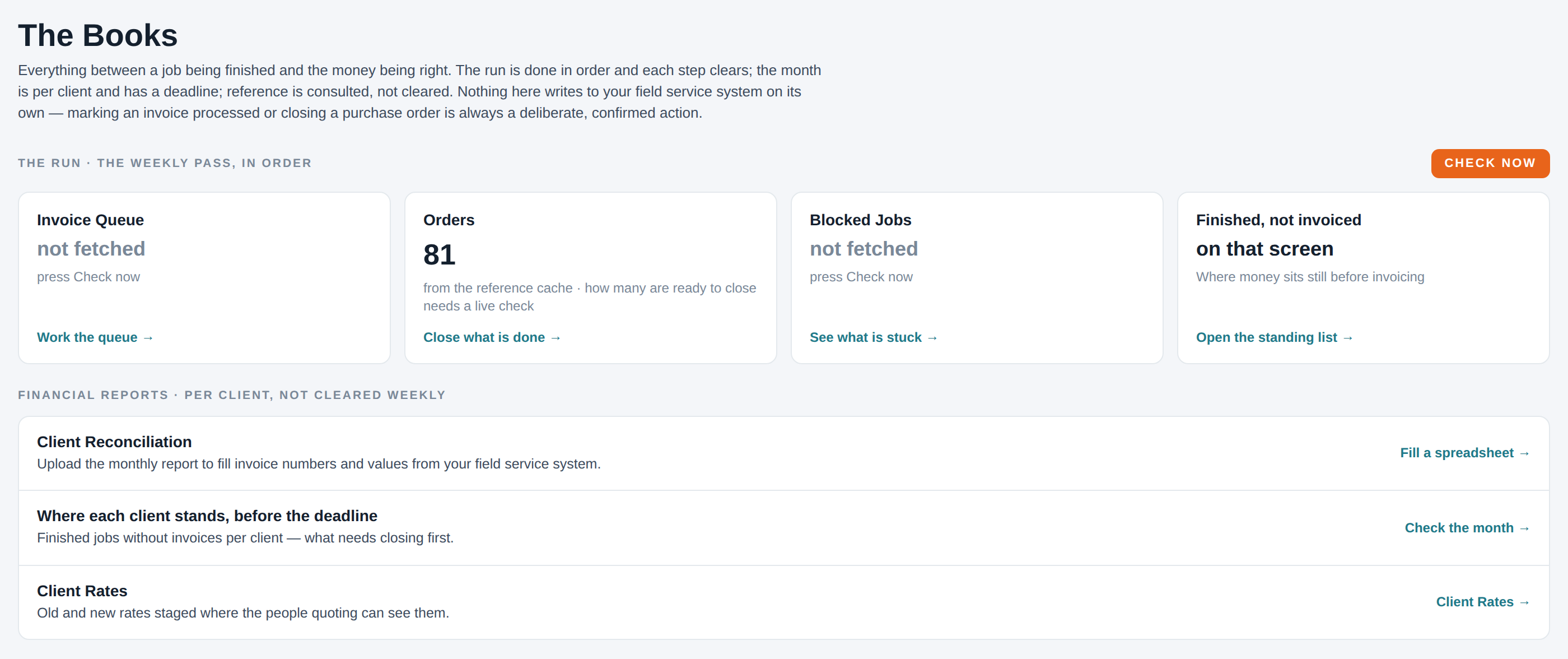
The Books overview: the weekly run in order — invoice queue, orders, blocked jobs, and finished work not yet invoiced
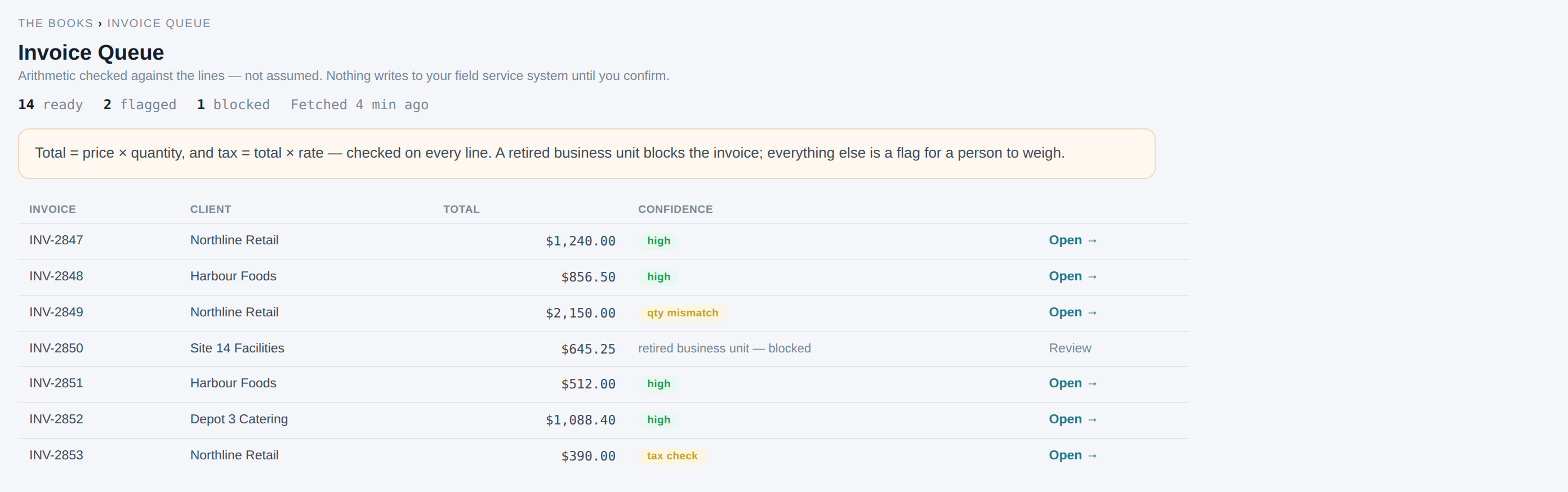
The invoice queue with confidence badges: high, qty mismatch, and a retired business unit blocked

Arithmetic, not a guess.

Total = price × quantity, and tax = total × rate — checked on every line, not assumed. Where a discount formula hasn't been confirmed against a real example yet, it's a note for a person, never folded into a pass. A retired business unit blocks the invoice outright.

→Confidence on every line, with the reason
→Marking processed is deliberate and confirmed
→Nothing reaches your field service system until you say so

Close what is actually done.

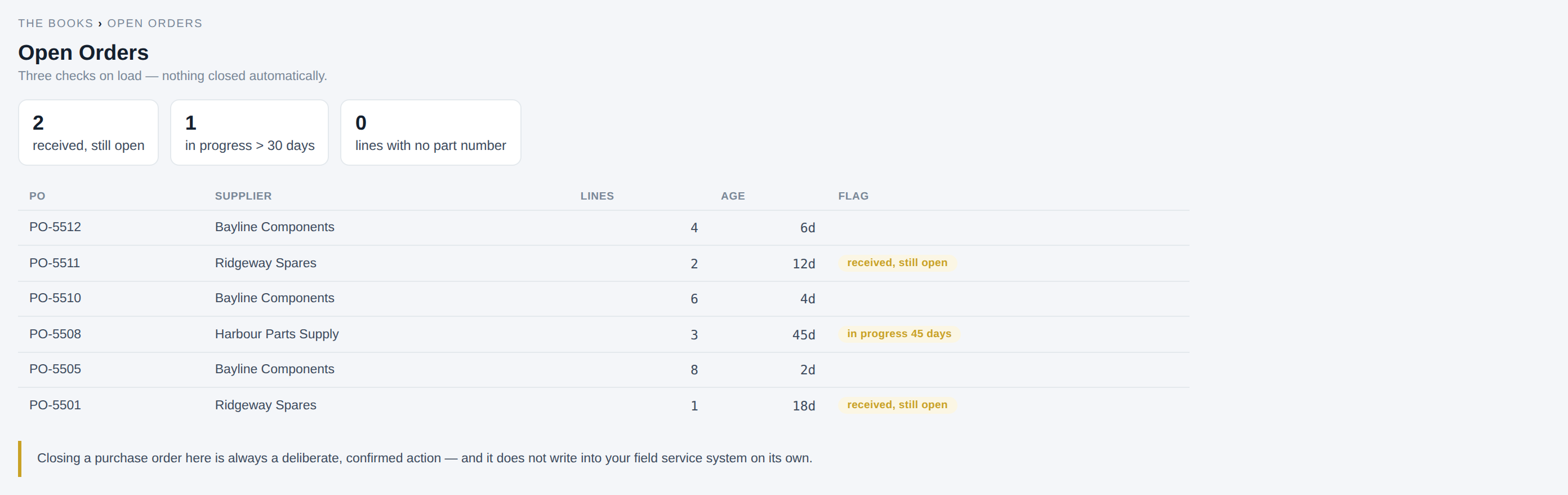
Open purchase orders checked on load: received but still open, in progress past a threshold, lines with no part number. Closing one here is always a deliberate, confirmed action — and it does not write into your field service system on its own.

→Flags you can act on, not a silent list
→Thresholds visible, not buried in a setting
→Confirm before anything is marked closed
Open orders list with flags for received-but-still-open and in-progress past 30 days
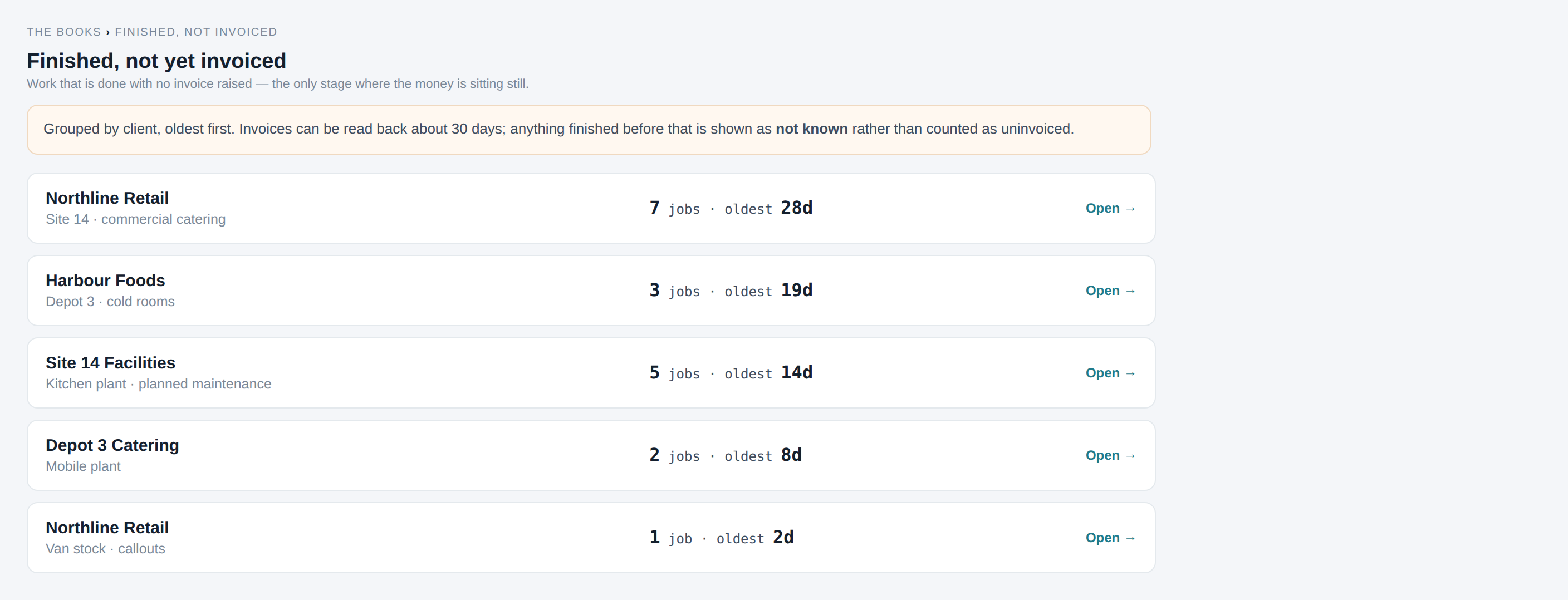
Finished but not invoiced, grouped by client with job counts and oldest age

Finished work with no invoice yet.

The only stage where the money is sitting still. Grouped by client, oldest first. Where TOWR can't read an invoice back far enough, it says not known rather than counting it as uninvoiced.

Client pricing where the people quoting can see it.

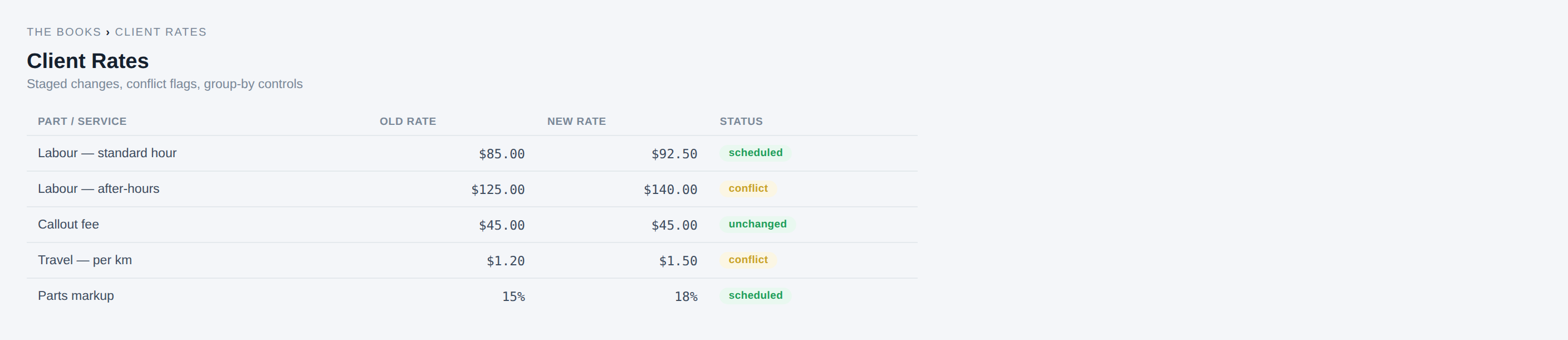
Old and new rates side by side, conflicts flagged before a quote goes out with the wrong number. The people who need the rate don't have to chase a spreadsheet.

Client Rates grid showing old and new rates staged, with a conflict flagged
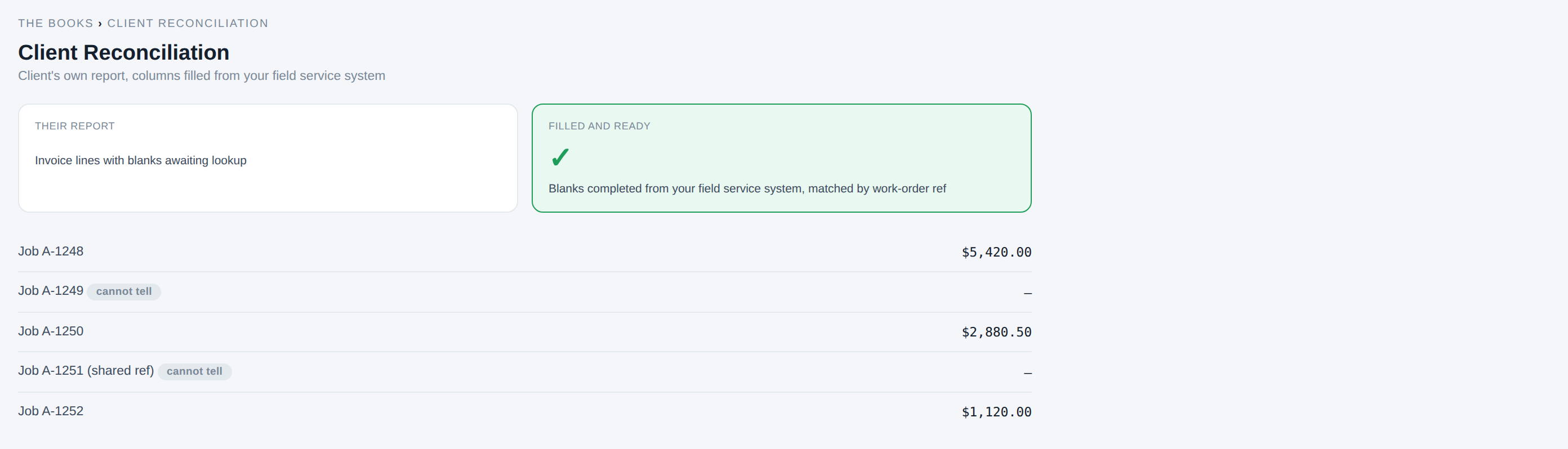
Client Reconciliation showing charged amounts against reference rates, with a row marked cannot tell

What was charged, next to what it should be.

Reference is consulted, not cleared. Upload the monthly spreadsheet a client sends with columns left blank — invoice numbers and values filled from your field service system, finished jobs moved across, ready to send back. Where TOWR can't tell, it says so.

Nothing here writes to your field service system on its own.

Marking an invoice processed or closing a purchase order is always a deliberate, confirmed action. Blank beats wrong: if a figure can't be verified, TOWR leaves it blank with the reason rather than inventing a confident zero. The seam stays visible — per action, with the reason attached.

Stop finding out on Friday.

See The Books against the rest of the product.