Every new business arrives with its own mailbox formats, its own client list, its own parts catalogue — none of it in TOWR's rules yet, because it doesn't exist until your data reveals it. Miles turns that into a rollout project in PEM: sequenced, chased, and visible to you. Prefer to do it yourself? He sits this one out.
Everywhere else in TOWR, deterministic rules win. Moving in is different — producing the rules is the job. A language model earns its keep exactly here: reading your history, proposing what to keep, and stopping when only a human can answer.
Sequencing, chasing, setup guidance, and an import walkthrough — the same line the product already draws. Nothing about credentials, autonomous changes, or a support SLA pretending to be magic.
Reads mailbox history and proposes sender, subject and intent rows — tested against your own messages before anyone accepts them.
Surfaces clients from mail and your backend — including ones that never made it onto a tidy list.
Field mappings tested on that customer's historical messages, not a generic template. Site, task-type and priority mappings from your own reference data.
Dedup detection, naming cleanup, size and weight when you have them — and graceful defaults when you don't. Never leaves you stuck because a field is blank.
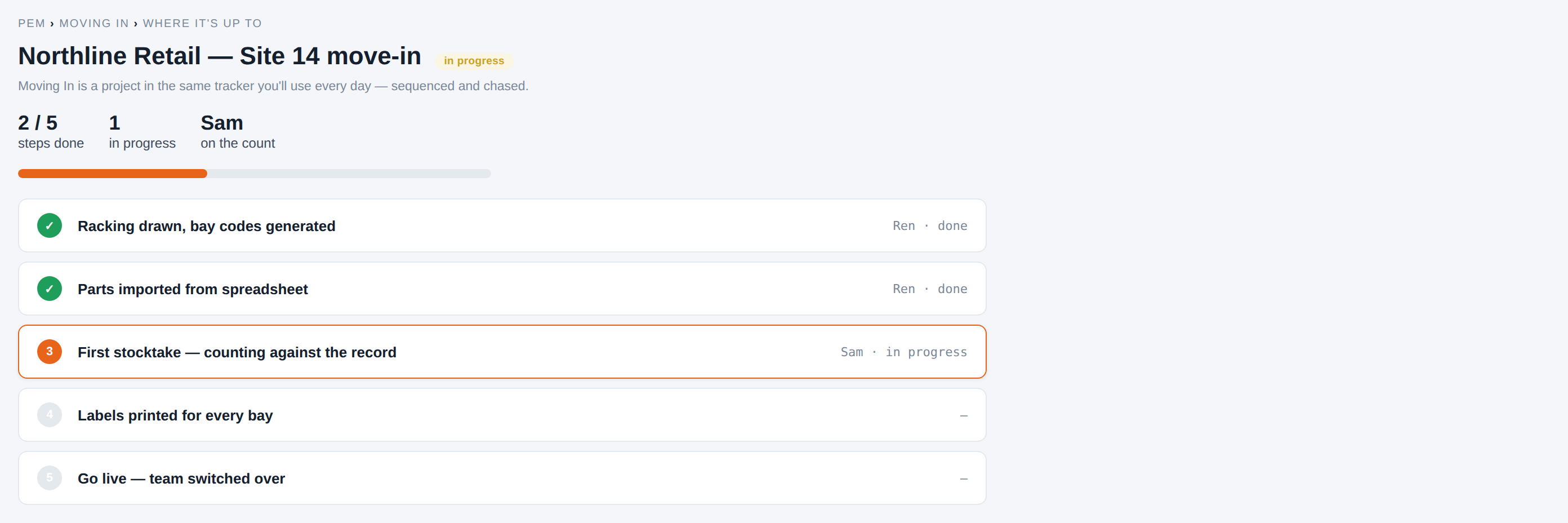
What's done, what's blocked, what needs a human decision — the project-manager part, visible in the same tracker you'll use every day after.
Never guesses past a real unknown. When only a person can answer, Miles waits — the same discipline PEM already uses for every other kind of work.
Your rollout becomes a real project in PEM — scoped, sequenced, and chased the same way Miles runs TOWR's own builds. You watch it happen in the tool you're adopting, not in a side spreadsheet about the move.
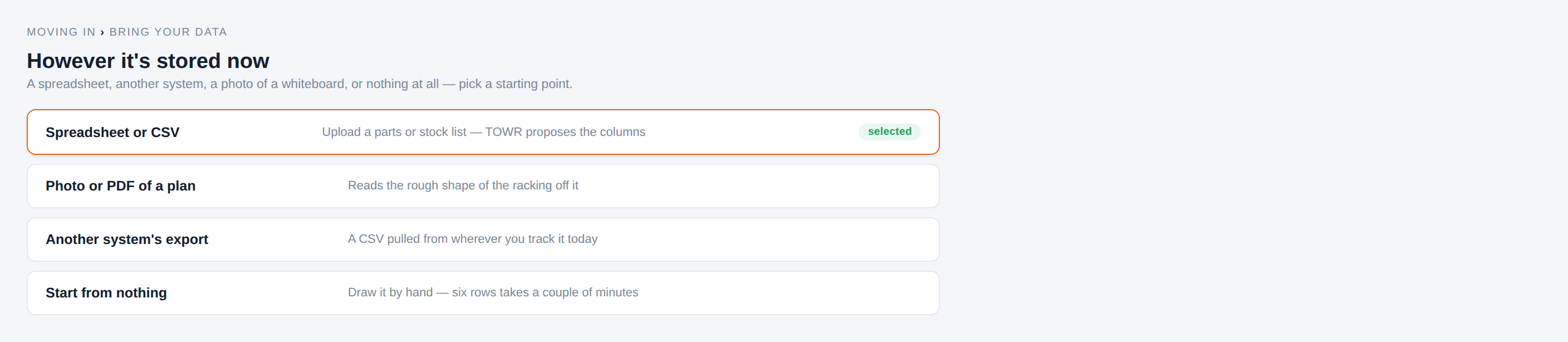
Parts arrive misspelt twice, blank where a supplier field should be, and half-measured. Smart Parts assumes that mess is normal: find duplicates, normalise names, use size and weight when they're there, and default conservatively when they're not. Machine grouping then runs against the cleaned catalogue — not the messy one.
A business that won't measure every part can't be told the feature doesn't apply. Miles degrades visibly and honestly — never invents silently.
Delete the AI key and everything that was accepted keeps working forever, unchanged. Every proposal is reviewed once, accepted once, and becomes ordinary durable data — no per-message cost forever, and no product that stops if the API is down. A human can type the same result in by hand and get it. Miles never writes behind your back: human-confirmed changes only, through the same real paths the product already uses.
Stated plainly so the promise stays inside its lines.
Good. Every Miles job has a manual way out — the same rule the product applies everywhere else. The built-in help guide covers the day-to-day, end to end.
That's where paid support comes in — stated plainly here, rather than found out partway through the move.
See the warehouse you're moving into — then the rest of the product.